Roman Empire
Le Morte d'ArthurThe Roman Empire appears in the narrative as both an imperial authority demanding Britain’s submission and a rival political order whose claim Arthur rejects. Its demand for tribute turns a dispute over sovereignty into war: Rome appeals to precedent and universal dominion, while Arthur answers that Britain owes no earthly ruler allegiance and claims the empire by descent from earlier British kings. The conflict culminates in Arthur’s defeat of Emperor Lucius and a calculated counter-tribute of the Roman dead, making the empire the measure against which Arthur’s kingship and ambitions are tested.
The Claim to Britain
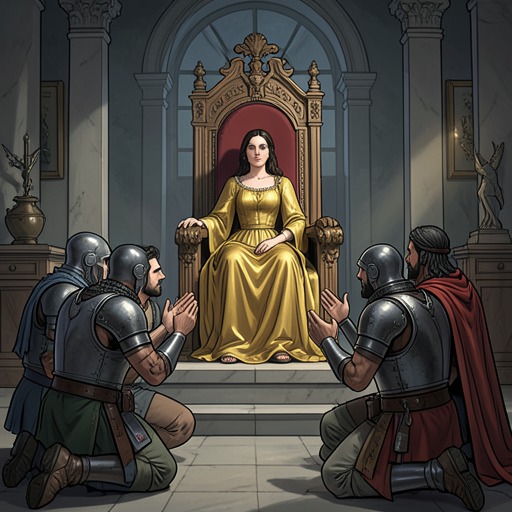
At a feast held after a long period of war, Arthur receives twelve elderly ambassadors sent by Lucius, the Roman emperor. Each carries an olive branch, a public token of their diplomatic mission. Speaking in Lucius’s name, they command Arthur to recognize the emperor as his lord and pay the tribute that, they claim, Arthur’s predecessors had rendered to Rome. They invoke Julius Caesar’s conquest and Roman decrees as the legal and historical basis for the demand, warning that refusal will bring a punitive war against Arthur’s lands and subjects.
The ambassadors’ argument makes sovereignty a contest over precedent as much as force: Rome presents itself as the established universal power, while Britain is described as a rebellious territory withholding what is due. Some young knights are so angered by the message that they would attack the envoys. Arthur forbids anyone to insult or harm them, orders that they be lodged and provided for generously, and insists that their treatment reflect his own honour even though their demands offend him. The scene distinguishes the protected status of messengers from the political disagreement they carry.
Arthur’s Counterclaim
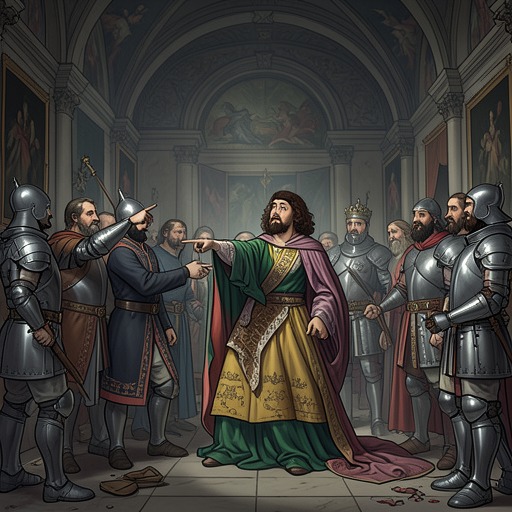
Arthur brings the matter before his lords and knights of the Round Table rather than answering in anger. Sir Cador of Cornwall welcomes the prospect of war as an opportunity for honour, but Arthur says the demand itself grieves him and seeks counsel. He rejects the notion that Britain owes tribute, citing the British kings Belinus and Brennius, who, he says, once held the empire, and Constantine, son of Queen Helen. In this account, British descent supplies a counter-history: Arthur does not merely deny Rome’s right to collect but asserts that his own predecessors give him a claim to imperial sovereignty.
Arthur’s allies endorse resistance and pledge military support. King Anguish of Scotland promises twenty thousand fighting men at his own expense; the king of Little Britain offers thirty thousand, and other lords make commitments of their own. With their support established, Arthur sends the ambassadors back to Lucius with a formal answer: he recognizes no tribute owed to the emperor or to any earthly prince, Christian or heathen, and intends to march on Rome and take possession of the empire. He nevertheless orders that the envoys receive gifts and have their expenses paid, and assigns Sir Cador to escort them from the country. Diplomatic courtesy and categorical refusal thus proceed together.
War and the Death of Lucius
The Roman challenge eventually meets Arthur’s army in the vale of Sessoyne. As the fighting develops, Arthur rides where the Romans most threaten his men, wielding Excalibur and rallying his forces. Sir Gawaine and the other knights of the Round Table also distinguish themselves. When Arthur encounters Lucius, the emperor wounds him; Arthur answers with a decisive blow, killing Lucius. The Roman army then flees, and Arthur’s side pursues it. The account reports more than a hundred thousand dead on Lucius’s side, a number that emphasizes the scale of the victory in the romance’s presentation of the campaign.
After the fighting, Arthur orders care for his own dead and wounded. He also attends to the bodies of Lucius and other prominent casualties, including the Sultan of Syria, the king of Egypt, the king of Ethiopia, seventeen additional kings, and sixty Roman senators. They are embalmed, wrapped in sixty layers of cloth, placed in lead chests, and marked with their shields, arms, and banners so their identities and countries will be known. The detailed preparation of the dead turns the aftermath into an organized political message as well as a burial duty.
Tribute Reversed
Arthur sends three surviving senators to Rome with the bodies and a message for the Roman authorities. He calls these remains the answer to the tribute Rome demanded and warns the Senate and Council not to demand tribute or taxes from him or his lands again. His bitter formulation leaves open the possibility of sending more dead if Rome is dissatisfied, while insisting that he owes no other payment. The bodies are therefore not merely the spoils of victory: dispatched in an ordered procession, they become a forceful counter-gift that reverses the direction of Rome’s demand.
The senators report the defeat and advise Rome not to renew the war, arguing that Arthur’s power, prowess, and fellowship of knights cannot be matched by an earthly prince. In the narrative, the Roman Empire’s claim to command Britain is defeated in the field, and Arthur’s answer reaches the Senate through the very envoys who had delivered Lucius’s ultimatum. The episode links imperial authority to the ability to make a claim, secure allies, wage war, and compel recognition; it also shows Arthur’s kingship taking shape through counsel, restraint toward diplomatic messengers, and decisive force.